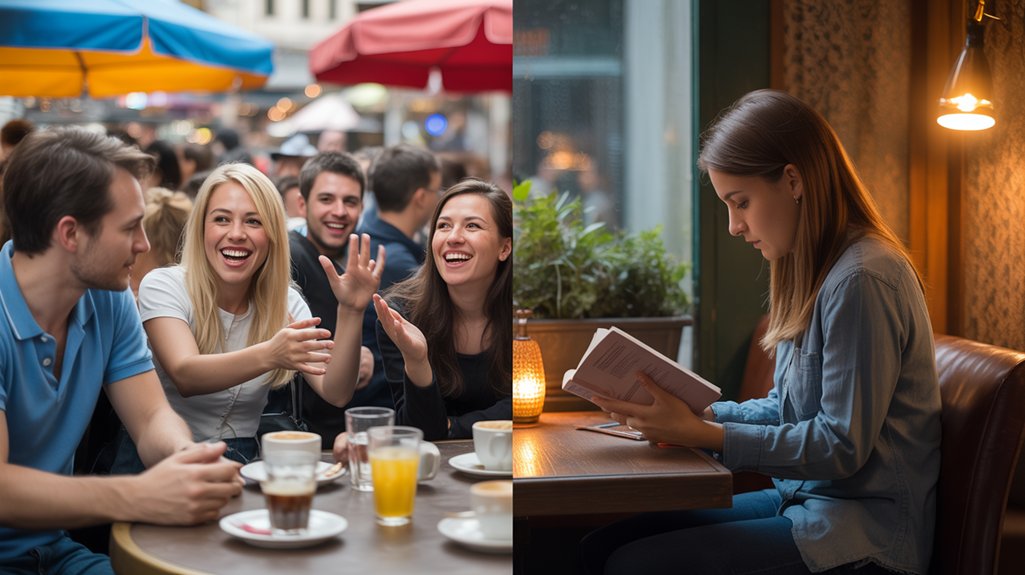
Extroversion dominates global populations, with studies revealing that 50-74% of people exhibit primarily extroverted traits, while introverts comprise approximately 25-40% of the general population. These percentages fluctuate considerably based on cultural contexts, with East Asian societies showing higher introversion rates due to collectivist values, whereas Latin American cultures demonstrate stronger extroverted tendencies. Geographic location, professional fields, and modern technology continue reshaping how these personality types manifest and interact in contemporary society.
Understanding the Fundamental Differences Between Introverts and Extroverts
While many people casually label themselves as either introverts or extroverts, the scientific reality behind these personality types reveals a complex psychological framework that extends far beyond simple social preferences.
Core Psychological Mechanisms
Introvert characteristics center on internal processing, where individuals naturally turn inward for energy restoration and decision-making. Research demonstrates that introverts show heightened activity in their prefrontal cortex, the brain region responsible for internal thought and planning.
Introverts demonstrate heightened prefrontal cortex activity, reflecting their natural tendency toward internal processing and thoughtful decision-making patterns.
Conversely, extrovert traits involve external stimulation-seeking behaviors, with brain scans revealing increased activity in the anterior cingulate cortex and temporal lobes. Dr. Hans Eysenck’s foundational research established that extroverts require higher stimulation thresholds to feel comfortable, while introverts become overstimulated more easily. These neurological differences create distinct behavioral patterns affecting communication styles, work preferences, and social energy management.
Statistical Breakdown: Population Distribution of Personality Types
These neurological distinctions manifest differently across global populations, with extensive research revealing surprising patterns in how introversion and extroversion distribute among various demographics. Multiple psychological assessments consistently demonstrate that personality spectrum distribution varies markedly across cultures, age groups, and professional fields.
| Demographic Category | Introversion Percentage |
|---|---|
| General Population | 25-40% |
| Creative Professionals | 60-70% |
| Corporate Leadership | 30-35% |
| Academic Researchers | 55-65% |
Research indicates that cultural factors heavily influence these distributions, with collectivist societies showing higher introversion rates compared to individualistic cultures. Professional environments also create distinct patterns, as certain careers naturally attract specific personality types, challenging common assumptions about workplace dynamics and leadership effectiveness across different industries.
Cultural and Geographic Variations in Introversion and Extroversion
Cultural boundaries create fascinating laboratories for personality expression, with geographic regions demonstrating remarkably distinct patterns in how introversion and extroversion manifest across different societies. Research reveals significant geographical differences in personality distribution, with East Asian cultures typically showing higher introversion rates compared to Western nations. Dr. Richard Lynn’s cross-cultural studies indicate that societal expectations heavily influence these patterns, as collectivist societies often reward introspective, harmonious behaviors while individualistic cultures celebrate outgoing, assertive traits.
Cultural influences extend beyond simple preference, shaping how personality types develop and express themselves. Scandinavian countries exhibit unique regional traits, balancing social cooperation with individual reflection. Meanwhile, Latin American cultures demonstrate higher extroversion levels, reflecting their emphasis on community interaction and expressive communication styles, illustrating how environment fundamentally shapes personality development.
The Rise of Ambiversion: When People Fall Between the Two Extremes
While traditional personality psychology has long categorized individuals as either introverts or extroverts, emerging research reveals that many people actually exhibit a blend of both traits, earning the designation “ambivert.” These individuals demonstrate remarkable adaptability, switching between introverted and extroverted behaviors depending on the situation, their energy levels, and social context. Understanding ambivert characteristics and their unique workplace strengths challenges the binary thinking that has dominated personality discussions for decades.
Defining Ambivert Personality Traits
Beyond the traditional binary of introversion and extroversion lies a third personality category that challenges the notion that people must fall neatly into one camp or the other. Ambiverts display a flexible combination of both introverted and extroverted tendencies, adapting their social approach based on situational demands and personal energy levels.
Core Ambivert Characteristics
Ambivert characteristics include balanced social preferences, moderate stimulation needs, and situational adaptability. These individuals comfortably navigate both solitary reflection and group interactions, neither craving constant social contact nor avoiding it entirely.
Behavioral Patterns
Ambivert behavior typically involves switching between outgoing and reserved modes depending on context, relationships, and internal state. They might enthusiastically lead meetings while preferring quiet evenings, demonstrating remarkable social versatility that researcher Adam Grant describes as “the best of both worlds.”
Ambivert Workplace Advantages
Modern workplaces increasingly recognize that ambiverts possess unique advantages that make them exceptionally valuable employees and leaders. Their balanced social energy allows them to adapt seamlessly between collaborative team projects and independent focused work, making them ideal for dynamic professional environments.
Ambivert leadership proves particularly effective because these individuals can connect with both introverted and extroverted team members, understanding diverse communication styles and work preferences. They excel at reading room dynamics, knowing when to speak up during meetings and when to listen carefully to others’ contributions.
Ambivert teamwork shines through their flexibility in group settings, where they can facilitate discussions without dominating conversations or provide steady support during high-pressure situations. This adaptability makes them natural bridges between different personality types within organizations.
How Modern Society Influences Personality Type Expression
Today’s digital landscape, workplace expectations, and technological advances create unprecedented pressures that fundamentally reshape how introverts and extroverts express their natural personality traits. Social media platforms reward extroverted behaviors like frequent posting and public engagement, while modern office cultures often favor collaborative, open-concept environments that can overwhelm introverted employees who thrive in quieter settings. These societal shifts force individuals to adapt their authentic personalities to meet external demands, creating a complex interplay between innate temperament and environmental expectations.
Social Media’s Personality Impact
Social media platforms have fundamentally reshaped how introverts and extroverts express their personalities, creating new avenues for connection while simultaneously challenging traditional behavioral patterns. These digital environments allow introverts to communicate more comfortably through written posts, while extroverts leverage live features and frequent interactions to showcase their personality traits.
| Introverts on Social Media | Extroverts on Social Media |
|---|---|
| Prefer curated, thoughtful posts | Share spontaneous, frequent updates |
| Excel in one-on-one messaging | Thrive in group discussions and comments |
| Build smaller, deeper online networks | Accumulate large follower counts |
| Often experience social media fatigue | Gain energy from online interactions |
Research indicates that social media can either amplify existing tendencies or provide compensatory outlets, depending on individual usage patterns and platform preferences.
Workplace Culture Pressures
Beyond the digital domain, contemporary workplace environments present unique challenges that often favor one personality type over another, creating systematic pressures that can force individuals to adapt or suppress their natural tendencies. Modern work culture typically emphasizes open collaboration, constant communication, and visible networking, which naturally aligns with extroverted strengths while potentially overwhelming introverted employees who thrive in quieter, more focused environments.
Team dynamics frequently reward those who speak up quickly in meetings, participate in brainstorming sessions, and engage in frequent informal interactions. These communication styles can inadvertently sideline introverts whose thoughtful, deliberate approach may be perceived as disengagement. Meanwhile, networking challenges disproportionately affect introverts, as career advancement often depends on building extensive professional relationships through social events and casual conversations that drain their energy reserves.
Leadership approaches increasingly favor charismatic, outgoing personalities, while creative collaboration emphasizes group work over individual reflection.
Technology Reshaping Social Behavior
While workplace environments have traditionally shaped how personality types express themselves, digital technology has fundamentally transformed the landscape of human interaction, creating new avenues for introverts to flourish while simultaneously demanding extroverted skills in unexpected contexts.
Digital communication platforms have revolutionized how introverts engage socially, offering controlled environments where they can process thoughts before responding. However, these same technologies have paradoxically contributed to increased social isolation across all personality types.
Modern technology’s impact includes:
- Online networking replacing face-to-face relationship building
- Social media personas blurring authentic personality expression
- Remote work platforms favoring written communication over verbal interaction
- Gaming communities providing structured social frameworks for introverted individuals
Research indicates that while introverts benefit from asynchronous communication methods, extroverts struggle with reduced spontaneous social opportunities in digital-first environments.
Practical Implications for Workplace Design and Social Interactions
The modern workplace has evolved dramatically from the industrial era’s one-size-fits-all approach, yet many organizations still struggle to accommodate the distinct needs of introverted and extroverted employees effectively. Research by workplace psychologist Dr. Susan Cain reveals that open offices, designed to enhance workspace collaboration, actually decrease productivity for introverts by 50%. Organizations are now implementing hybrid environments featuring both collaborative spaces and quiet zones. Social dynamics shift markedly when companies provide multiple interaction options: brainstorming rooms for extroverts who think aloud, and written feedback systems for introverts who process internally. Companies like Google and Microsoft have successfully redesigned their offices with personality-specific zones, resulting in 30% higher employee satisfaction scores and improved innovation metrics across both personality types.